AI: Grok Bot Delegates to Claude, ChatGPT Gets a New Face, Claude Cowork Moves to the Cloud
You can order the same kind of articles for your own video to boost it on YouTube and Google. Just message the Telegram bot @sat_sit_bot. Articles with your video embedded are written and posted by the bot itself — on popular topical sites (no ads). Free trial — 50 articles.
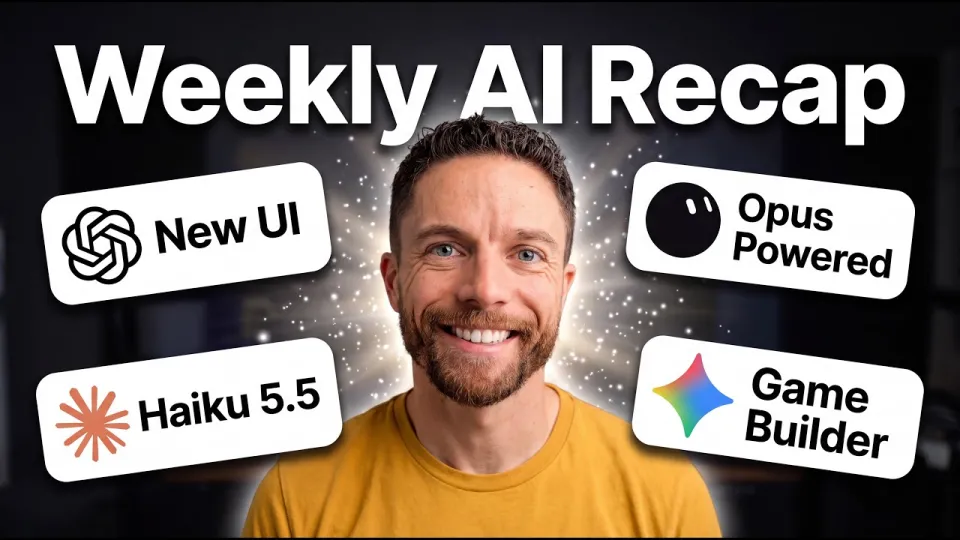
AI this week moved in one clear direction: the assistants stopped competing on raw model quality alone and started competing on orchestration, interface and pricing. Grok Bot is being built to hand work off to Claude, Midjourney and Suno; ChatGPT is getting an "Intelligent UI"; Claude Cowork is leaving the desktop for the cloud. The full walkthrough comes from Paul J Lipsky's weekly recap, and the sponsor link for Okou — an AI workspace you can try via the Okou sign-up page — is where the episode's promo code applies.
What Grok Bot actually changed: delegation instead of a single model
Grok Bot's headline move is that it stops pretending one model has to do everything. The agent is designed to route parts of a job to outside tools — Claude for reasoning-heavy text work, Midjourney for images, Suno for audio — while Grok remains the front end the user talks to. In practice that means a single request can fan out into several specialized services and come back assembled.
The pattern is familiar from enterprise automation stacks, but it is new at the consumer chat layer:
- You describe the outcome, not the tool.
- Grok Bot picks a model or service per subtask.
- Outputs are merged into one deliverable — a script, a storyboard, a clip.
That is why the demo that resonated most with viewers involved a folder of business videos: point the bot at the assets, describe the social clip you want, get a voice script, record it, hand it back, and receive a finished edit. The interesting part is not that an AI edited video — it is that the agent chained file access, scripting, transcription and assembly without the user choosing a model at any step.
ChatGPT's Intelligent UI: the interface starts making decisions
ChatGPT's new look is less a redesign than a shift in who controls the layout. Under the "Intelligent UI" label, the assistant decides which tools, canvases and panels to surface based on what you are doing, rather than showing the same wall of buttons to everyone. A coding question can pull forward a code canvas; an image request can open the generator inline; a research task can expose browsing and sources.
The trade-off is predictability. Users who built muscle memory around a fixed layout will find controls in different places, and the interface's choices are only as good as its read of your intent. The upside is that capabilities buried three menus deep — the ones most people never discover — become reachable at the moment they are relevant.
Anthropic: Claude Cowork goes cloud-first
Claude Cowork's move to the cloud removes the biggest practical limitation of agentic work: the laptop. Previously, a long task lived and died with the machine running it. Cloud execution means a job can keep going after you close the lid, and it can be picked up from a different device.
For teams, that changes the failure modes. Instead of "my session died," the questions become permissions, shared context and who can see what an agent did. Anthropic has been steadily pushing Claude from a chat window toward a colleague that holds state — Cowork in the cloud is the infrastructure step that makes that credible for real workflows rather than demos.
Separately, the Claude Haiku line keeps coming up in the same conversation: cheap, fast models are what make always-on agents economically viable, because most subtasks in a long chain do not need a frontier model.
Google: Gemini plan changes, Nano Banana 2.1 and the Playground test
Google's week was about packaging. Gemini subscription tiers were reshuffled, and the detail worth flagging is that higher storage bundles now sit alongside access to Google's top-tier model — a bundling logic that makes the plan comparison less about the model name and more about what else comes in the box. Anyone mid-subscription should re-read what their tier now includes rather than assume last year's feature list.
On the model side, Nano Banana 2.1 continues Google's rapid iteration on image generation, with the emphasis on editing consistency — keeping a subject recognizable across changes rather than producing one good still. The AI Playground test in the recap is the practical counterpart: a place to poke at these models before committing to a paid tier.
Questions viewers keep asking about the new AI stack
The recurring confusion in the comments is not about benchmarks — it is about access and setup. Three themes dominate.
First, the mystery of the "primary" bot. A Grok Bot appearing unannounced in an account reads as a security event to a normal user, and at least one viewer deleted it assuming another bot had spawned a rogue assistant. Product teams should treat unexplained agents in a user's workspace as a trust problem, not a UI detail.
Second, the Claude Code gap. The loudest request under the recap was a walkthrough of Claude Code for non-technical people — evidence that agentic coding tools are being adopted by operators, marketers and founders who want the output without the terminal vocabulary.
Third, cost and plan clarity. The observation that a Google AI Plus plan now carries a Pro model plus 2TB of storage is exactly the kind of detail that decides a purchase, and exactly the kind that gets lost when coverage focuses only on model launches.
Why orchestration is the story, not any single model
Read the week together and the pattern is structural. Grok Bot delegating to Claude, Midjourney and Suno says the value is in routing. ChatGPT's Intelligent UI says the value is in surfacing the right tool at the right moment. Claude Cowork in the cloud says the value is in execution that outlives a session. Google's plan reshuffle says the value is in the bundle.
None of those are pure model-quality claims, and that is the point. The frontier labs have converged enough on capability that the differentiators users actually feel are orchestration, persistence, interface and price. Expect the next round of announcements to be judged on those terms — and expect agent permissions and auditability to become the question nobody can defer.
Final takeaway
The practical lesson from this week's AI news is to stop evaluating assistants one prompt at a time and start evaluating them as systems: what they can delegate, what they remember, what they can reach, and what they cost when they run unattended. Paul J Lipsky's weekly format is useful precisely because it puts those threads side by side instead of treating each launch as an isolated event. If you want to test an AI workspace yourself, start at Okou's registration page, where the recap's code KJZN8RVG takes 20% off one month of Pro or Team for the first 100 redemptions.
Key takeaways
- Grok Bot is being positioned as an orchestrator that can hand tasks to Claude, Midjourney and Suno instead of doing everything in-house.
- ChatGPT is rolling out an "Intelligent UI" that changes how the assistant looks and how it decides which tools to surface.
- Claude Cowork moves off the desktop and into the cloud, so long-running work no longer depends on one machine staying awake.
- Google reshuffles Gemini subscription tiers and pushes Nano Banana 2.1, its image model, alongside the AI Playground test.
- Okou, the sponsor of the recap, offers a 20% discount on Pro or Team for one month with code KJZN8RVG, limited to 100 redemptions.
Source: Weekly AI Recap: GrokBot Just Did the Unthinkable, ChatGPT Looks Completely Different & More! · Markdown version
Questions & answers
Can Grok Bot really use Claude, Midjourney and Suno in one workflow?
That is the design goal described in the recap: Grok acts as the front end and routes subtasks to specialized services, including Claude for text reasoning and Midjourney or Suno for media. In practice the quality depends on how well the routing handles your specific request, so test it on a real deliverable rather than a demo prompt.
Why did ChatGPT's interface change so much?
The new "Intelligent UI" lets the assistant decide which tools and panels to show based on the task instead of displaying a fixed layout. It surfaces capabilities that used to be buried in menus, at the cost of some predictability for users with established habits.
What does Claude Cowork in the cloud mean for long tasks?
Cloud execution means an agent's work no longer stops when your laptop sleeps or closes. Jobs can continue server-side and be resumed from another device, which shifts the practical questions to permissions, shared context and visibility into what the agent did.
Is it worth upgrading a Gemini plan after the tier changes?
Re-read what your tier now includes, because the reshuffle ties top-model access to storage bundles rather than standing alone. If you mainly need image generation and a large storage allowance, the combined package may be better value than a model-only comparison suggests.