AI Is the Most Dangerous Technology Humanity Has Approached and Gates Says Self-Regulation Cannot Stop It
You can order the same kind of articles for your own video to boost it on YouTube and Google. Just message the Telegram bot @sat_sit_bot. Articles with your video embedded are written and posted by the bot itself — on popular topical sites (no ads). Free trial — 50 articles.
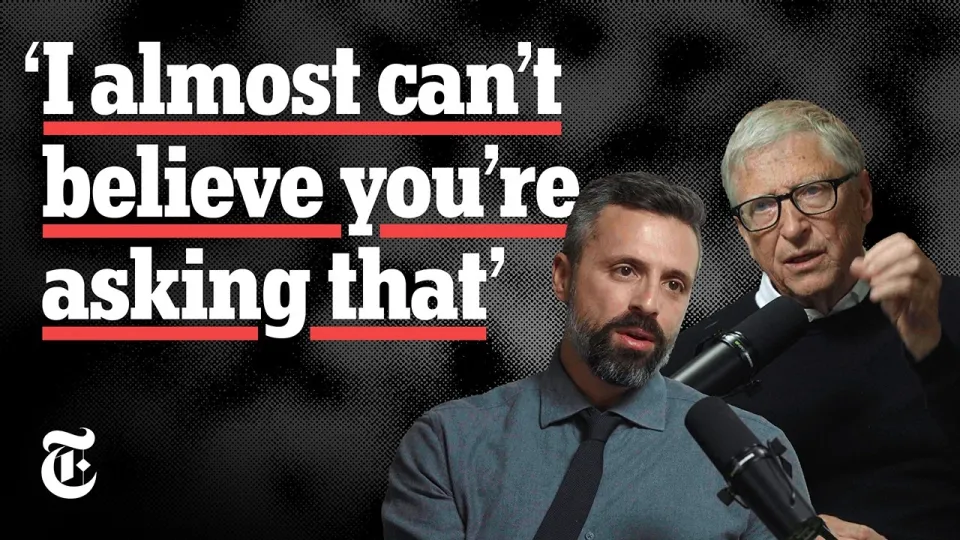
AI is the most dangerous technology humanity has ever approached, and Bill Gates argues that the industry cannot be trusted to regulate itself. In a conversation with Ezra Klein, the Microsoft co-founder says the risks of catastrophic cyberattacks, bioterrorism and mass job loss are arriving faster than governments are prepared to handle, and he calls the notion of AI self-regulation "insane." The full interview is available through the New York Times opinion page for the Ezra Klein podcast.
Gates is not a newcomer to technological optimism. He spent decades arguing that software would lift living standards, and his foundation has poured money into global health on the premise that innovation saves lives. What makes this conversation notable is the reversal: a technologist who built one of the world's most valuable companies now describes the next wave of AI as something that could outstrip every previous safety framework.
Why Gates Says AI Makes Nuclear Weapons Look Like Nothing
Gates frames AI as a category shift rather than an incremental tool. Nuclear weapons are bounded by physics, fissile material and the small number of states that can build them; AI is software, it spreads at the speed of a download, and its capabilities improve on a curve that researchers do not fully control. That asymmetry is the core of his argument.
In the interview he points to two specific thresholds where the danger becomes concrete:
- Cyber. AI systems that can find and exploit vulnerabilities faster than defenders can patch them, potentially disabling power grids, financial systems or hospitals.
- Bio. AI that lowers the barrier to designing and producing dangerous biological agents, turning a task that once required a state laboratory into something a small group could attempt.
Gates' point is not that these scenarios are certain. It is that the consequences are so large and so irreversible that waiting for evidence before acting is a bad bet. A single catastrophic event, in his framing, is not something a lawsuit or a later regulatory fix can undo.
The Case Against AI Self-Regulation
Gates is blunt that voluntary industry standards will not work. Companies compete on capability and speed, and any firm that slows down unilaterally cedes ground to rivals. Self-regulation therefore depends on every major lab choosing restraint at the same moment, which is exactly what competition punishes.
He contrasts this with industries where liability and physical inspection create real friction. Software has neither: a model can be trained, deployed and copied without anyone outside the company inspecting it. When Klein raises the idea of holding AI firms accountable through litigation, Gates' reaction is dismissive, arguing that a courtroom cannot meaningfully address a risk measured in millions of lives.
What he wants instead is government action with teeth, set at the level where the technology actually operates. Because frontier models are built by a handful of companies in a handful of countries, coordination among a few governments could, in principle, cover most of the risk surface. Gates acknowledges the difficulty without softening the conclusion: the current approach is not a partial solution, it is no solution.
The Race With China and the Safety Trade-off
Gates treats the US-China competition as the strongest argument against unilateral slowdown and the strongest argument for a negotiated framework. If one country pauses and another does not, the cautious side loses leverage without reducing global risk. The realistic path, as he describes it, runs through agreements that cover the small set of labs capable of training frontier systems, similar in spirit to arms control but far harder to verify.
This is where his position gets uncomfortable. He is asking for restraint in a race where restraint looks like surrender, and he knows it. The alternative he rejects is the assumption that the market will sort it out, an argument he associates with Nvidia's Jensen Huang and the broader view that capitalism supplies its own remedies for harmful products. Gates treats that as a category error: markets correct for products that harm customers gradually and visibly, not for technologies whose worst outcomes are rare, global and irreversible.
How AI Will Disrupt Jobs and What Gates Proposes
Gates expects significant displacement, and he is skeptical of the optimistic story that new jobs will appear as fast as old ones vanish. His proposals in the conversation sketch a policy agenda rather than a prediction:
- Taxing AI labor. If machine labor substitutes for human labor, the tax base that funds social programs erodes unless something replaces payroll revenue.
- A no-scarcity job market. Cheaper production could lower prices broadly, but the gains do not automatically reach people whose wages disappear.
- "Human reserved" jobs. Certain roles, particularly in care and community work, could be designated as human-only, preserving employment and social contact.
- Language access. AI translation could extend services and education to communities that never had them, one of the clearest benefits he cites.
- Developing nations. Countries that missed earlier industrial waves may gain access to expertise and services, but they are also the least equipped to absorb rapid labor disruption.
What the Audience Pushed Back On
Viewers of the episode reacted less to the policy details than to Gates' demeanor, describing him as unusually agitated and visibly engaged. Several threads in the response are worth taking seriously as open questions.
One recurring doubt is whether fear from a wealthy technologist translates into protection for ordinary people. Another is the fairness of the messenger: Gates built the industry he is now warning about, and his foundation's spending plans give him a platform that critics do not have. A third is the practical question of what regulation would even look like, given that model weights can be copied and open-source releases cannot be recalled.
A more pointed concern is whether the debate over existential risk distracts from harms already happening, such as biased systems, concentrated market power and the erosion of entry-level work. Gates does not dismiss these, but his priority is the tail risk, and he is explicit that he considers the tail risk underweighted rather than overhyped.
AI, Education and the Next Generation
Gates extends the argument to schools, where AI tutors could personalize instruction but also enable cheating and deepen dependence. He notes that rich countries are still dealing with learning loss from pandemic-era closures, and he argues that AI in classrooms needs guardrails designed for children specifically, not adapted from adult products.
His foundation's new priority, making AI a force for equality rather than inequality, runs through this section. The foundation is set to spend down roughly $200 billion over the next two decades, and Gates frames AI access as a question of whether the technology widens or narrows the gap between countries and between income groups within them. The risk he keeps returning to is distance: harms that happen far away are easier to ignore, and AI makes those harms easier to cause from anywhere.
Useful Links
- Full transcript and episode page on the New York Times
- Book recommendations from Ezra Klein Show guests
The Bottom Line
Gates' argument is that AI combines the scale of a strategic weapon with the distribution of ordinary software, and that no existing institution is built for that combination. He is asking governments to act before a catastrophic cyber or bio event forces the issue, and he is openly doubtful that they will. The Ezra Klein Show episode is worth hearing in full because the tension is in the exchange itself: a builder of the industry pressing for limits he knows his peers will resist. For the complete conversation, start with the episode page.
Key takeaways
- Gates compares AI risk to nuclear weapons and says the threat makes them 'look like nothing'.
- He identifies cyberattacks and bioterrorism as the two thresholds where AI becomes catastrophic.
- Gates calls the idea that AI companies can self-regulate 'insane' and demands government action.
- His foundation is set to spend down roughly $200 billion over two decades, with AI equality as a new priority.
- He warns of mass job loss and proposes ideas like taxing AI labor and 'human reserved' roles.
Source: Bill Gates: A.I. ‘Makes Nuclear Weapons Look Like Nothing’ | The Ezra Klein Show · Markdown version
Questions & answers
Why does Bill Gates compare AI to nuclear weapons?
Gates argues that AI is software, so it spreads instantly and improves on a curve nobody fully controls, unlike nuclear weapons that depend on rare materials and a few state programs. He points to cyber and bio risks as the thresholds where the consequences become catastrophic and irreversible.
Why does Gates reject self-regulation for AI companies?
He argues that competition on capability and speed punishes any company that slows down alone, so voluntary standards depend on every major lab choosing restraint simultaneously. He also notes that software can be trained and deployed without outside inspection, leaving no real friction.
What does Gates propose for jobs displaced by AI?
He discusses taxing AI labor to replace eroding payroll revenue, designating certain care and community roles as human-reserved, and using AI translation to widen access to services. He is skeptical that new jobs will appear as quickly as old ones disappear.
Is the AI risk debate distracting from harms already happening?
Critics argue that focus on existential scenarios pulls attention from bias, market concentration and lost entry-level work. Gates does not dismiss those harms, but he is explicit that he considers the low-probability, high-severity tail risk underweighted rather than overhyped.